
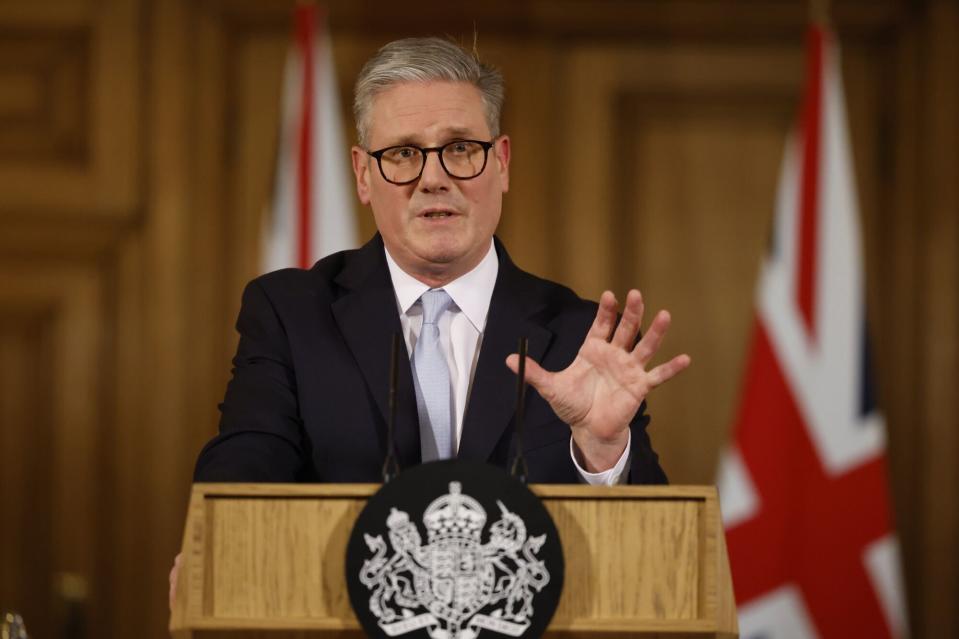

Prime Minister Keir Starmer has vowed to cut net immigration to the UK, following new data showing that migration levels remain at historically high levels despite previous government measures. In a statement that blamed the Conservative Party for failing to reduce numbers, Starmer promised a fresh approach to immigration under his leadership.
The Immigration Crisis: Record Highs Despite Efforts to Curb It
Recent official data has revealed that net migration to the UK hit a staggering 906,000 for the 12 months through June 2023, with projections estimating an additional 728,000 arrivals through June 2024. This is a dramatic increase compared to 2019, when net migration was recorded at just 184,000. These figures highlight the sharp rise in immigration since the Brexit referendum and the pandemic, despite efforts from the Conservative Party to limit the number of people entering the UK.
Starmer, whose Labour Party took power in a landslide election victory earlier this year, blamed the Conservative government for the surge in immigration during their 14 years in power. According to Starmer, the Tories had “experimented with open borders,” which led to a sharp rise in net migration. “I want to see immigration come down significantly,” Starmer said, underscoring the need for a major shift in policy.
Starmer’s Promise: A White Paper on Immigration Control
At a recent press conference, Starmer made it clear that cutting immigration would be a top priority for his government. He also announced that a white paper outlining the government’s plans to reduce net migration would be published soon. This document is expected to detail how the new Labour government intends to tackle immigration, including measures to combat people smuggling and address the pressure on public services.
In addition to his general commitment to reducing immigration, Starmer pointed to a border agreement with Iraq aimed at curbing human trafficking and smuggling gangs that have exploited the UK’s immigration system. He acknowledged the complexity of the immigration issue but emphasized that his government would do more to bring down numbers where the previous administration failed.
The Political Divide on Immigration
Starmer’s position on immigration is part of a broader political debate. For years, immigration has been a divisive issue in UK politics, with concerns over the impact of high numbers on housing, jobs, and public services. The topic was a major driver behind the 2016 Brexit referendum, where many voters supported leaving the European Union in part to regain control over immigration.
During the last Conservative government, immigration was a key issue, but despite promises to bring numbers down, net migration continued to rise. Conservative politicians like Kemi Badenoch, who became the leader of the opposition in September 2024 after Rishi Sunak’s resignation, admitted that her party had failed to meet its promises on immigration. “We promised to bring numbers down, but we didn’t deliver,” she said, acknowledging the failure of the Tory government to effectively manage migration.
As a response, Badenoch suggested that if the Conservative Party wins the next election, it would review the European Convention on Human Rights and the Human Rights Act, both of which she believes have complicated efforts to reduce immigration. She also suggested setting a cap on net migration if the Tories regain power.
How Will Starmer Tackle Immigration?
While Starmer has committed to reducing immigration, the specifics of his plans remain to be seen. The UK’s immigration system is complex, with various routes for migrants including students, workers, refugees, and asylum seekers. Many industries, such as healthcare and agriculture, rely on migrant workers to fill vital roles, making any immigration cuts potentially controversial.
In particular, the healthcare sector has been a major point of debate. Over the past few years, the NHS has become increasingly dependent on migrant workers, especially in roles that local workers have been unwilling to fill. With a shortage of healthcare professionals in the UK, reducing immigration could lead to greater pressure on an already struggling NHS.
The Labour government’s approach is expected to focus on tougher border control measures and cooperation with countries like Iraq to combat smuggling. However, critics argue that immigration cuts could lead to further labour shortages in key sectors.
The Future of UK Immigration Policy
Keir Starmer’s stance on immigration marks a sharp shift from the Conservative approach, which has failed to deliver on promises to reduce migration. Starmer’s pledge to cut immigration significantly is likely to shape the political landscape in the coming months, with the potential to have a profound impact on the UK’s economy, public services, and international relations.
As the Labour government prepares to outline its detailed immigration strategy, it remains to be seen how the policies will balance the needs of the UK’s economy with the demand for tighter controls. Whether these measures will be successful in reducing migration, while also addressing concerns over human rights and labour shortages, will be a key challenge for Starmer and his administration.
Conclusion: A New Era for Immigration?
Keir Starmer’s promise to cut immigration comes at a time when the issue is at the forefront of UK politics. The data showing record migration numbers under the Conservative government has given Starmer a platform to push for change. His government’s forthcoming white paper will outline the direction for the future, but how effective these measures will be remains to be seen.
With the debate over immigration likely to continue as the next election approaches, both Labour and the Conservative Party will need to address the complex issues surrounding immigration, jobs, and public services if they hope to win over voters. The path ahead will not be easy, but one thing is clear: immigration will remain a major political battleground in the UK for the foreseeable future.

