
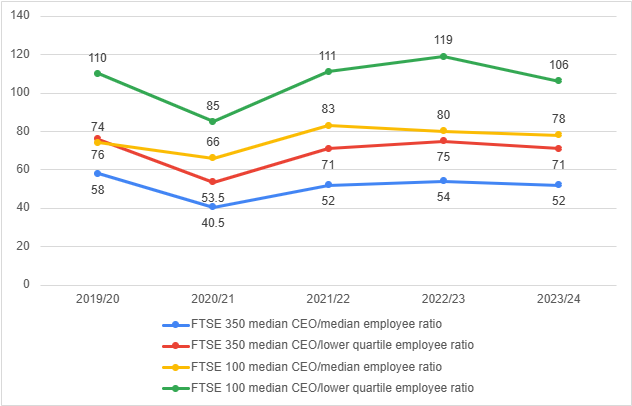

The pay gap between the UK’s top executives and the average worker has come again into the spotlight, after a recent report by the High Pay Centre outlined stark disparities across the corporate landscape. Chief executives of FTSE 350 companies earned a median pay of £2.5 million in 2023–24, according to the study, equivalent to 52 times the salary of a typical worker.
The revelation has reignited an ongoing debate about fairness, governance, and corporate responsibility-most of all, as millions of workers continue to grapple with stagnant wages and rising living costs. The data illustrates a worrying picture of growing inequality at the very top of the corporate pyramid, with many questioning whether such enormous executive rewards are truly justified by performance.
A Snapshot of Executive Compensation
The pay ratio between CEOs and employees remains alarmingly high, says the report, despite calls for greater accountability and transparency in executive remuneration. The average CEO in the FTSE 100 now earns 78 times more than the median employee, while for the lowest quartile of the workforce, the ratio leaps to an astonishing 106 times.
Executive packages include not just base salaries but also generous bonuses, stock options, pension contributions, and performance-linked incentives. Sometimes, the total remuneration is further bolstered by long-term incentive plans that can deliver multi-million-pound windfalls based on share performance — even when the company’s overall financial health remains mediocre.
While companies often justify these figures on the basis that they need to “attract and retain world-class talent,” critics counter that the current model rewards short-term results and excessive risk-taking rather than sustainable business growth and the well-being of employees.
The Workers’ Perspective
The difference could not be sharper for the average UK worker. Wages have grown modestly in the past year, but much of those gains have been whittled away by inflation and the cost of living. In sectors such as retail, logistics, and hospitality – where so many FTSE companies are dependent on big workforces – employees increasingly feel squeezed given scarce pay growth and shaky contracts.
Unions and worker advocates argue the huge pay disparity is not only a morale issue but also reflects deeper cultural problems in corporate governance. “When a chief executive earns more in three days than the average employee does in a whole year, something is fundamentally broken,” said a spokesperson for the Trades Union Congress. “We need to build an economy where rewards are shared more fairly.”
Government and Regulatory Response
The UK government has adopted several measures over the years to bring in checks and balances on inflated executive pay. Listed companies now have to disclose their CEO median-employee pay ratio and justify high compensation levels in annual reports. Shareholders also have the right to vote on executive pay packages under a mechanism known as the ‘say on pay’ system.
Critics counter that those measures have done little to stem the tide. Disclosure to the public and shareholder votes have had little consequence, while CEO pay has continued to rise steadily. Many institutional investors abstain or vote in favor of pay proposals because the pay is aligned with short-term financial metrics.
The High Pay Centre has called for stronger interventions, including employee representation on remuneration committees and clearer guidelines to tie bonuses with broader performance indicators such as workforce satisfaction, sustainability goals, and long-term growth.
Corporate Culture and Public Perception
Beyond financials, the CEO pay debate is also about trust. Public confidence in large corporations has been eroded by stories of excessive executive rewards alongside layoffs, automation, and cost-cutting drives. A growing number of consumers, investors, and employees are questioning whether such compensation structures align with modern values of equity and social responsibility.
The John Lewis Partnership and Nationwide Building Society are among the UK companies which have experimented with fairer pay ratios and profit-sharing models. These cases indicate that success mustn’t be at the expense of equity — a lesson more corporations may soon need to learn to retain goodwill from the public and loyalty among employees.
The Road Ahead
Pay inequality will continue to be in sharp focus as the UK economy faces a period of uncertain, sluggish growth, geopolitical tension, and technological disruption. Economists warn that widening disparities could harm productivity, weaken consumer spending, and erode social cohesion.
The challenge for corporate Britain is to balance competitiveness with conscience: to reward leadership that drives innovation and resilience without alienating the very workforce on which it depends. While there is no single panacea, more openness, real accountability, and a move towards purposeful capitalism might be the keys that narrow the gap. Otherwise, the gulf between boardroom bonuses and average pay will likely continue to define and divide the modern British workplace.

