
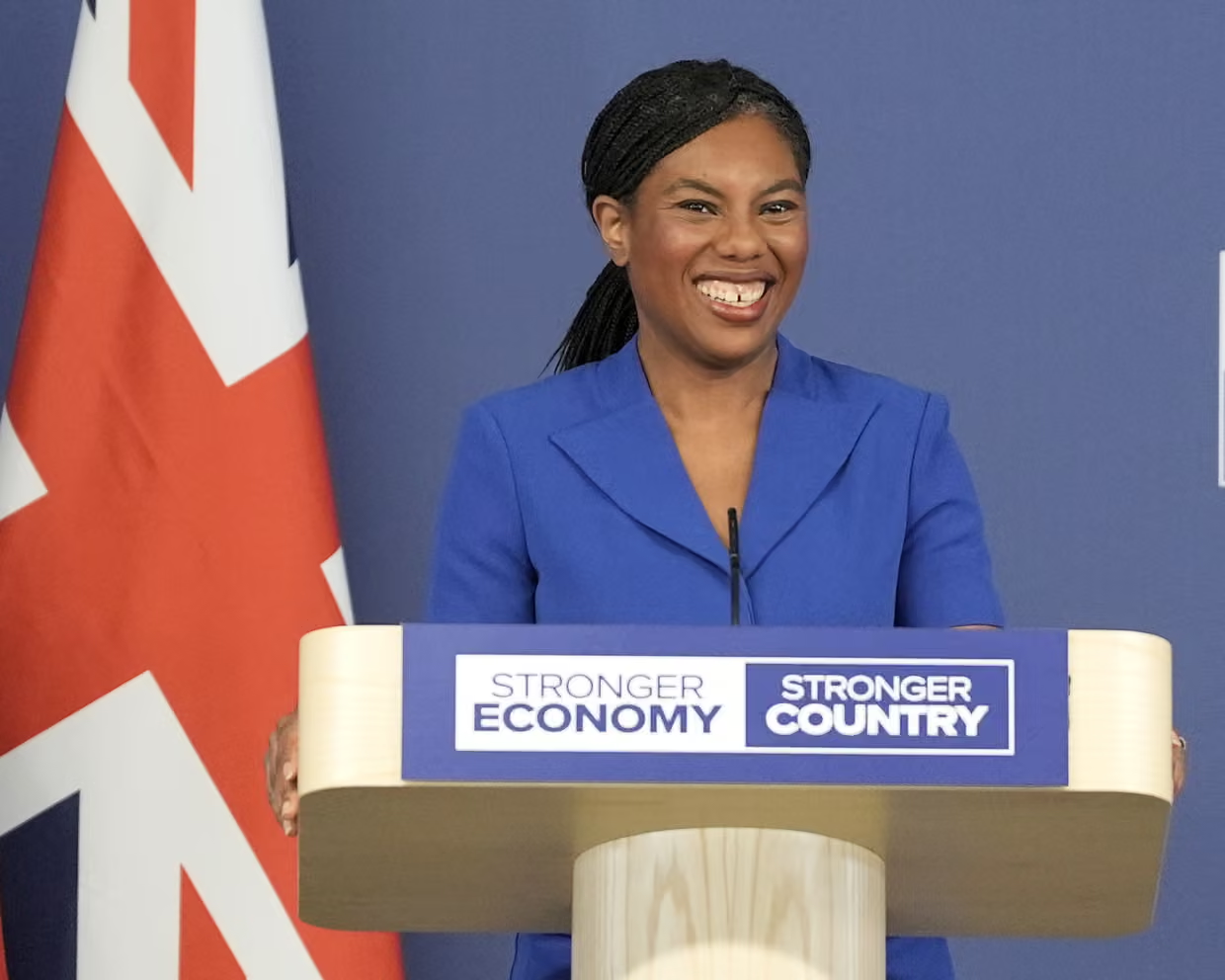

A sharp political dispute has erupted in the United Kingdom after Labour accused Conservative leader Kemi Badenoch of using the escalating Iran crisis to score political points.
The criticism came after Badenoch attacked Prime Minister Keir Starmer during a speech at the Conservative Party’s spring conference. She accused Starmer of being hesitant and failing to show strong leadership in response to the recent US-Israel strikes on Iran.
Labour officials quickly pushed back, saying the situation requires serious leadership rather than political attacks.
Defence Minister Calls for “Serious Politics”
UK Defence Minister Al Carns criticized Badenoch’s comments, urging political leaders to focus on responsible decision-making during an international crisis.
Carns said the situation in the Middle East demands “serious politics,” not rhetoric aimed at gaining political advantage.
His remarks reflected Labour’s view that the escalating conflict with Iran should not become a tool for domestic political battles.
According to Labour officials, the government has been carefully assessing the situation before deciding on the United Kingdom’s role in any military operations.
Badenoch Criticizes Starmer’s Leadership
During the Conservative Party’s spring conference in Harrogate, North Yorkshire, Badenoch delivered a strong criticism of the prime minister’s response to the crisis.
She argued that Britain needs decisive leadership during international conflicts and suggested that Starmer had been too hesitant to act.
Badenoch told party members that the country currently has a prime minister who is “too afraid of making the wrong decision” and therefore unwilling to make a decision at all.
Her remarks drew applause from supporters at the conference and signaled that the Conservatives intend to challenge Labour’s foreign policy approach.
Starmer’s Initial Position on the Iran Strikes
The controversy centers on the United Kingdom’s response to the military strikes carried out by the United States and Israel against Iran.
At first, the British government chose not to participate in the initial military action. Starmer also declined to allow the United States to use UK Royal Air Force bases for launching the attack.
The decision reflected a cautious approach, as the government evaluated the potential consequences of becoming directly involved in the conflict.
However, the situation later evolved.
RAF Shifts to Defensive Operations
After the initial strikes, the UK government announced that the Royal Air Force would participate in defensive operations rather than offensive attacks.
The move signaled a limited involvement focused on protecting British forces and facilities in the region.
Tensions escalated further when an Iranian drone strike hit an aircraft hangar at RAF Akrotiri in Cyprus, one of the United Kingdom’s key military bases in the region.
The attack highlighted how quickly the conflict could spread beyond the initial strikes and potentially threaten British military assets.
Growing Political Debate in the UK
The Iran crisis has quickly become a major political issue in Britain.
Opposition parties often use foreign policy decisions to question the government’s leadership, particularly during moments of international tension.
For the Conservatives, the situation presents an opportunity to challenge Labour’s handling of national security.
For Labour, the priority is demonstrating that its decisions are guided by strategic considerations rather than political pressure.
Balancing Caution and Leadership
The disagreement between the two parties reflects a broader debate about how the United Kingdom should respond to global conflicts.
Some politicians argue that Britain must act quickly and decisively alongside allies such as the United States.
Others believe that careful evaluation and restraint are necessary to avoid being drawn into prolonged military conflicts.
Starmer’s government appears to be attempting to strike a balance between those positions by offering defensive support while avoiding direct participation in offensive strikes.
A Debate Likely to Continue
With tensions between Israel, the United States and Iran still developing, the political argument in Britain is unlikely to fade anytime soon.
The government will continue to face pressure to explain its decisions and outline the country’s role in the evolving conflict.
Meanwhile, opposition leaders are expected to keep questioning whether the government is doing enough to protect national interests and support international allies.
As the crisis unfolds, the debate over leadership, caution and military involvement will remain a central issue in British politics.

