

The UK has been grappling with a deeply controversial issue that has sparked intense debates about child sexual abuse, race, and political responsibility. The so-called “Pakistani grooming gangs” scandal centers around cases of child sexual exploitation where predominantly Pakistani-origin men were involved in grooming and exploiting vulnerable white girls in northern cities like Rotherham, Rochdale, and Oxford. The scandal has led to national outrage, accusations of institutional failure, and political infighting.
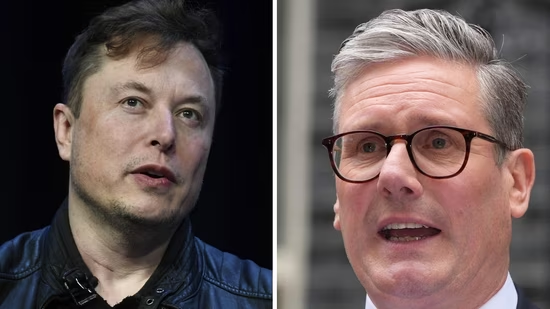
The controversy intensified after a high-profile murder case involving a 10-year-old British-Pakistani girl, Sara Sharif, and debates over grooming gangs resurfaced in UK politics. The scandal gained further momentum with political figures, including Elon Musk, weighing in on the issue, leading to a public row between UK Prime Minister Keir Starmer and the billionaire entrepreneur.
The Grooming Gangs Controversy
The term “grooming gangs” became widely used to describe criminal groups of men, mostly from Pakistani Muslim backgrounds, who preyed on young, vulnerable girls, grooming them for sexual exploitation. Over the years, investigations revealed that these gangs were operating in several UK towns and cities, exploiting underage girls as young as 11 or 12. The cases shocked the nation, and the details of the abuse were often horrifying, with the victims suffering years of physical and psychological trauma.
The issue has been particularly controversial for a few reasons:
- Ethnic and Religious Background: Many of the perpetrators in high-profile cases were of Pakistani Muslim descent, leading to accusations of racism and claims that authorities were reluctant to take action due to concerns about being labeled racist or Islamophobic.
- Institutional Failure: Investigations showed that local authorities, including police and social services, failed to act on multiple reports of abuse. Some critics argue that these failures were due to political correctness and a reluctance to address the issue due to the ethnicity of the perpetrators.
- Political Debate: The issue has been at the center of fierce political debate, with calls for national inquiries, public accountability, and reforms in child protection practices. However, some politicians have criticized the idea of framing the issue as a cultural problem tied to certain communities, saying it could perpetuate harmful stereotypes.
Recent Developments: Political Tensions Over Child Protection
In the latest twist, the Conservative Party pushed for a national inquiry into the issue of grooming gangs, hoping to force Prime Minister Keir Starmer to take a harder stance. However, this proposal was rejected by MPs in a vote, with the Government’s child protection legislation still progressing despite the political fallout.
In December 2024, MPs debated whether to include a national inquiry into the issue in new child protection laws following the brutal murder of Sara Sharif, a 10-year-old British-Pakistani girl. The debate was tinged with political bitterness. Some Conservative lawmakers argued that failure to hold an inquiry would suggest a cover-up by authorities. The debate was largely influenced by the Conservative party’s desire to highlight what they perceive as failures in the government’s handling of the grooming gangs issue.
However, the UK government, led by Keir Starmer, rejected calls for a national inquiry into grooming gangs, with the proposal failing to pass a vote by a large margin. 364 MPs voted against it, while only 111 supported it. This move has been controversial, with opponents arguing that it could be seen as downplaying the severity of the issue.
Keir Starmer’s Response and Elon Musk’s Public Criticism
Keir Starmer, the Labour leader and Prime Minister, has been firmly defending his record, asserting that his party has taken decisive action in the past, particularly in prosecuting the perpetrators of grooming gangs when he served as Director of Public Prosecutions (DPP). He believes that those calling for a new national inquiry are spreading misinformation and are more interested in fueling political division than addressing the victims’ needs. Starmer’s government has prioritized child protection and has backed improved safeguards for home-schooled children following Sara Sharif’s tragic case.
However, the debate over the issue has spilled into the realm of social media, with high-profile figures like Elon Musk publicly weighing in. The billionaire entrepreneur has been outspoken about what he sees as political correctness interfering with addressing the issue head-on.
In a series of tweets on X (formerly Twitter), Musk criticized Starmer’s stance, accusing him of avoiding the truth and of being more interested in protecting political allies than addressing the scale of the abuse. Musk has been a vocal critic of the UK’s left-wing politics and what he perceives as an over-sensitivity to issues of race and religion.
His remarks have sparked a back-and-forth between him and Starmer’s supporters, with many arguing that Musk’s comments are unhelpful and could exacerbate the issue by framing it in a divisive way.
The Political Fallout
The conflict between Starmer and Musk is just one aspect of the larger political drama surrounding the grooming gangs issue. The controversy has polarized public opinion in the UK, with some seeing the need for an independent inquiry into the issue, while others believe it risks demonizing certain communities.
Some political analysts argue that the Conservative Party is using the grooming gangs issue to weaken Starmer and his Labour government, painting them as soft on crime. On the other hand, Starmer’s allies believe that the focus should remain on protecting children and not getting sidetracked by political point-scoring.
What’s Next for the Grooming Gangs Scandal?
The political wrangling over grooming gangs is likely to continue in the coming months, as child protection legislation moves forward in Parliament. The Prime Minister’s stance on not holding a national inquiry has created a raging debate about whether the country is truly committed to addressing the scale of the abuse and ensuring accountability for those responsible.
As for Elon Musk, his involvement in the debate reflects a broader global conversation about free speech, accountability, and the politics of identity and race. Whether Musk’s criticisms will affect public opinion or simply escalate the political gridlock remains to be seen.
What is clear is that the grooming gangs scandal is far from over, and it continues to shape political discourse in the UK—particularly as the country grapples with the balance between protecting children and confronting sensitive, complex social issues.

