
UK House Prices Surge Close to Record High at 2024’s End: What It Means for Buyers in 2025

UK House Prices Near Record High: What’s Driving the Market in 2024?
As 2024 came to a close, UK house prices were almost back to their record highs, showing that the property market continues to defy expectations despite the country’s sluggish economy. According to Nationwide Building Society, house prices jumped by 0.7% month-on-month, reaching an average of £269,426 ($338,000). This is just a tiny step below the peak of £273,751 ($343,000) seen in the summer of 2022, marking an impressive rebound in the property sector.
Why Are House Prices Rising?
The housing market’s resilience in 2024 is a rare bright spot in the UK economy, which has faced challenges in other areas. Here’s what’s keeping house prices high:
1. Strong Buyer Demand
Despite affordability challenges, demand for homes remains solid. Nationwide’s report highlights that mortgage approvals have surged to their highest level in over two years, showing that people are still eager to buy homes.
2. Rising Real Incomes
Real incomes in the UK have been on the rise, meaning that, for many buyers, wages are starting to stretch a little further. This extra income has given some potential buyers more confidence to enter the housing market.
3. The End of Political and Economic Uncertainty
The UK saw a major shift in October with Labour’s first budget under new leadership. The budget spared consumers from major tax hikes, and the Bank of England (BOE) provided a psychological boost by cutting interest rates twice in 2024. These moves gave buyers more financial confidence, helping to prop up demand for housing.
How Much Did House Prices Increase?
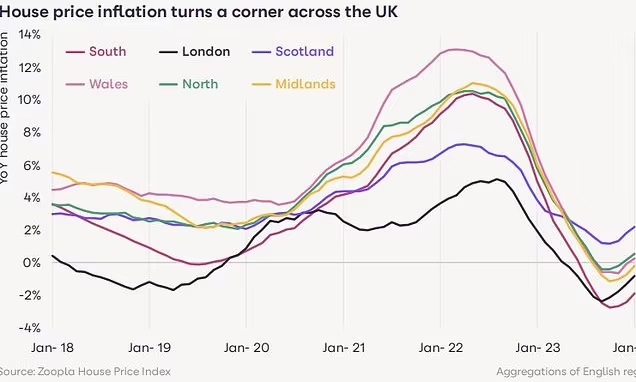
Nationwide’s data shows that house prices rose by 4.7% in December 2024 compared to the same month the previous year. All regions of the UK saw price growth, with Northern Ireland leading the charge at a 7.1% year-on-year increase.
In England, a noticeable north-south divide is emerging, with house prices in northern England growing at 4.9%, outpacing the 2.2% growth in the south. This suggests that buyers in the north are seeing better value for money as prices in the south, especially in London and the southeast, remain higher.
What’s Ahead for 2025?
Looking into 2025, the outlook for the UK housing market is mixed. On one hand, house prices could continue to rise as demand remains strong. On the other hand, affordability challenges are likely to persist, especially with interest rates still relatively high.
Mortgage Market Challenges
While there’s been some easing of borrowing costs thanks to rate cuts from the Bank of England, mortgage rates have edged up in recent months. After the budget, markets have raised concerns that rate cuts could slow down, meaning prospective buyers might not see the same relief they hoped for in 2025.
Robert Gardner, Nationwide’s chief economist, explained that mortgage market activity has been surprisingly resilient in 2024, but affordability will still be a major concern for many buyers. The cost of borrowing is expected to remain high for most of 2025, limiting the amount people can borrow and pushing house prices out of reach for some.
Stamp Duty and Transaction Surge
One major event that could influence the market in early 2025 is the stamp duty change. In April 2025, the threshold at which stamp duty (a tax on home purchases) kicks in is set to lower, making it more expensive for buyers to purchase homes above a certain price. As a result, many people are expected to rush to complete their purchases before this deadline, leading to a boost in housing transactions during the first three months of 2025.
However, this may lead to a drop-off in transactions once the new threshold takes effect, similar to what happened when the stamp duty threshold changed in the past.
What Does This Mean for Buyers in 2025?
If you’re looking to buy a home in 2025, here’s what you should keep in mind:
1. Limited Affordability Relief
Affordability remains the biggest issue. While mortgage rates may come down slightly in 2025, they’re still likely to be higher than what buyers have become used to in the past. That means for many buyers, homes may still feel out of reach.
2. Potential for Continued Price Growth
If demand continues to outstrip supply and interest rates stay somewhat stable, house prices could continue to climb, particularly in regions like Northern England where growth is stronger than in the South.
3. Act Fast Before Stamp Duty Change
If you’re hoping to save money on your property purchase, you might want to consider acting before April 2025 when the stamp duty threshold changes. Getting in early could mean avoiding higher taxes, which might help ease some of the financial pressure.
Where Are House Prices Growing the Fastest?
As mentioned, the north-south divide is becoming more pronounced in the UK housing market. Northern England is seeing stronger growth compared to the South, which could make it an attractive option for first-time buyers or those looking for better value.
Here’s a quick look at regional performance in 2024:
- Northern Ireland: The top performer with a 7.1% increase in house prices year-on-year.
- Northern England: A 4.9% growth, leading the way in the country.
- Southern England: Slower growth, with 2.2% increases, particularly in London and the Southeast.
Conclusion: The UK Housing Market in 2025
The UK housing market has proven its resilience in 2024, and the momentum looks set to continue into 2025. Prices have risen, buyer demand remains strong, and there’s potential for more growth in certain regions. However, affordability challenges remain a key concern, especially with the possibility of only limited relief from interest rate cuts.
For buyers, the next few months could be crucial. If you’re thinking of buying, consider moving quickly before the stamp duty changes in April 2025 and be prepared for a market where prices might keep climbing. As always, it’s important to weigh your options carefully and plan accordingly for the challenges ahead.

